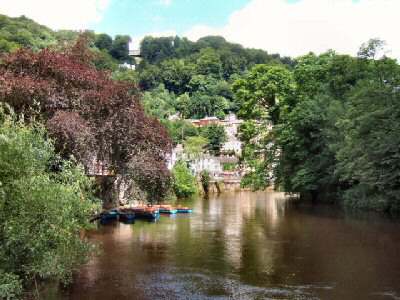
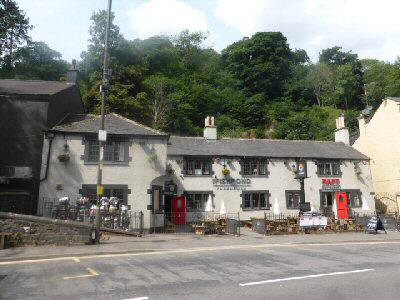
Matlock Bath Walk guarantees superb views at any time of the year, but best of all on a sunny day when the trees are not in full leaf. A word of warning, the steep descent through Hagg Wood can be slippery in wet weather and positively dangerous after frost.
During the early stages of the walk, the Heights of Abraham can be seen. In the summer, cable cars glide back and forth, taking visitors to the top of the pleasure grounds that have been in use since the 1780s.
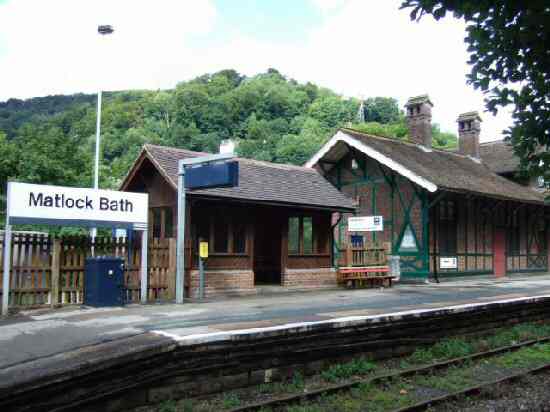
The Swiss-style station building houses an interesting display by the Derbyshire Wildlife Trust. The station was designed in this style to reflect the description given to the area as the ‘Switzerland of England.’
LOOK OUT FOR
Route Point 1 – In Victorian times, Matlock Bath was known as ‘Little Switzerland’, and Matlock Bath Railway Station was built to a Swiss design to reflect the description given to the area. It is now one of the stations along the scenic line from Derby to Matlock. The Matlocks were originally a string of small settlements, and it was not until the discovery of medicinal springs in Matlock Bath at the end of the 17th century that much attention was paid to the area.
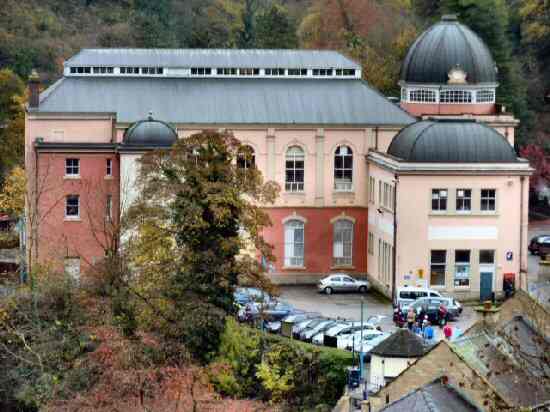
Point 4 – Housed in the Grand Pavilion is the Peak District Mining Museum, the only one of its kind in the world. It tells the story of lead mining from Roman to recent times, interestingly and innovatively, with climbing shafts and tunnels providing a real insight into what working down in a lead mine was really like. Close by is the Temple Mine, which offers the opportunity to go underground on a guided tour to learn more about the history of mining.
Matlock Bath Railway Station
Grand Pavilion, Matlock Bath
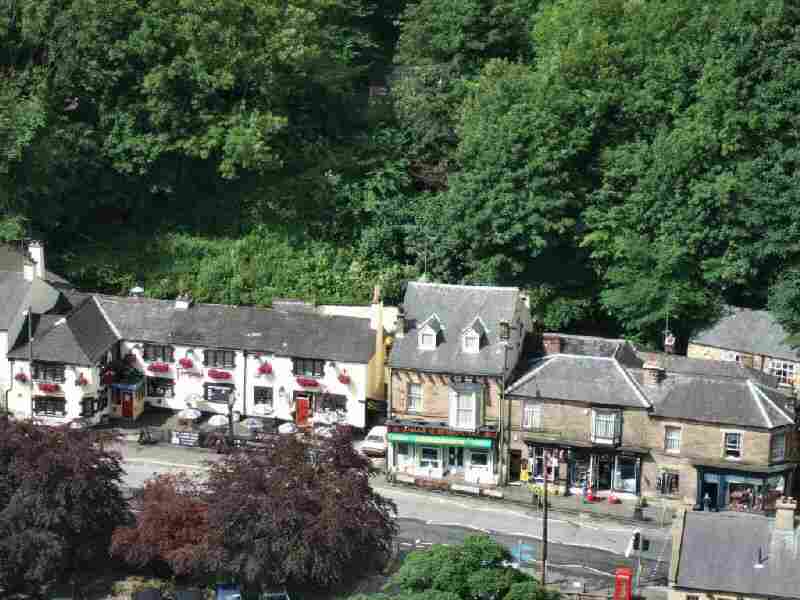
Point 5 – During the early stages of the walk, the Heights of Abraham can be seen. Cable cars glide back and forth, taking visitors to the top of the pleasure grounds that have been in use since the 1780s. When Queen Victoria visited Matlock Bath in 1844, she ascended the Heights of Abraham on a donkey. Nowadays, visitors usually use the cable cars that first started to operate in 1984. The more energetic take the strenuous option and walk.
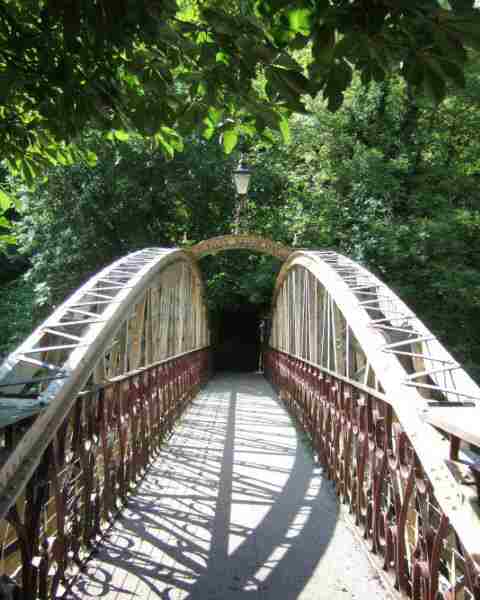
Point 6 – Jubilee Bridge dates to 1887 and underwent restoration work in 2014 at a cost of £214,000. It was constructed to commemorate Queen Victoria’s Golden Jubilee. The bridge is made of wrought iron and was designed by Thomas Gillott and manufactured at the Butterley Iron Works. It replaced a previous ferry to Lovers’ Walks.
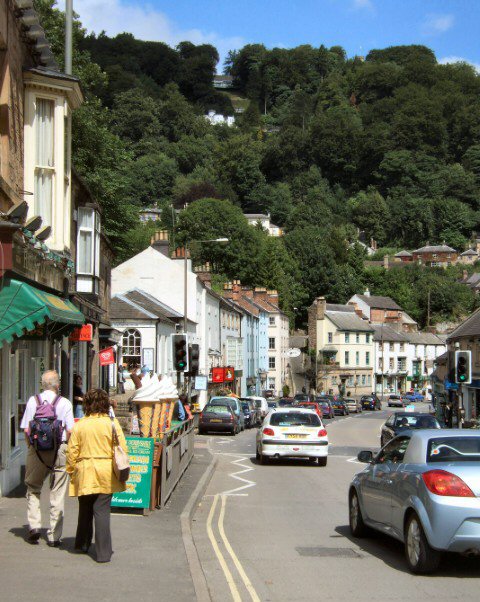
Looking up towards Heights of Abraham
Jubilee Bridge 1887, Matlock Bath
WALK DETAILS
Length: 2.5 miles
Start: Matlock Bath Railway Station/Car Park (SK298585)
Location: On the A6 from Derby to Matlock, one and a half miles from the latter (SK296589). The Railway Station is at the northern end of the main shopping area, just off the A6, where there is a large pay-and-display car park. There is a good bus service to Matlock Bath, with bus stops on either side of the main road by the Lead Mining Museum/Fishpond Hotel and just north of the railway station turn-off.
Terrain: Some steep ascents and descents, but the superb views more than compensate. The descent through Hagg Wood (Route Point 3) near the start of the walk is steep and uneven and can be slippery in wet weather and positively dangerous after frost. Enjoy the fantastic views from the fenced viewing points over High Tor.
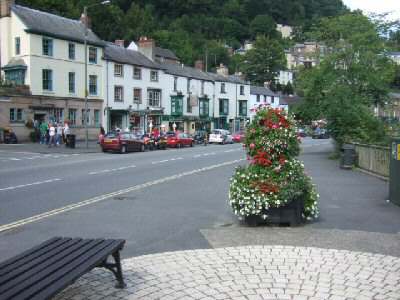
Refreshments: There is a good choice of pubs, cafés, and restaurants in the village to suit all tastes.
THE ROUTE
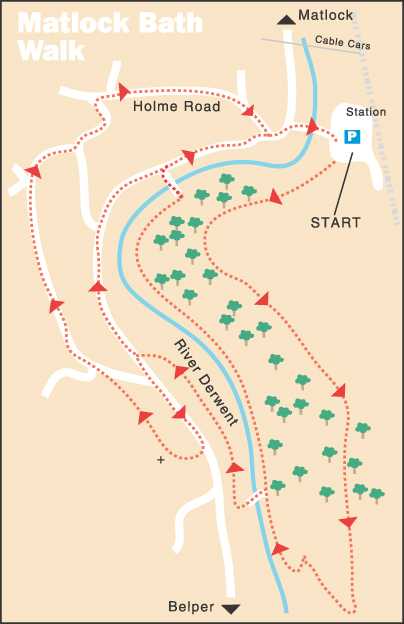
1. Leave Matlock Bath Railway Station and walk through the coach parking area, which is directly opposite the main car park. Here you join a path rising above the River Derwent. 2. The path climbs steadily close to the fence on your left to the top of the cliff. Continue along the cliff path, with excellent views through the trees of Matlock Bath below. Ignore all paths to the right, and follow the path as it bends to the left with fields on your left and Starkholmes only a short distance away. When the route ahead is blocked with bushes and a fence, turn to the right to start descending the hillside. 3. The path through Hagg Wood is steep and uneven and can be slippery in wet weather and positively dangerous after frost. Follow the path as it descends in a zigzag fashion through the wood to reach the River Derwent. Here you turn to the right and walk along the riverbank path until you reach a bridge, New Bridge, which you cross. 4. Turn right into Derwent Pleasure Gardens and continue your walk along the riverbank before going to the left past the side wall to the Grand Pavilion to reach the A6. Where you go to the left along the A6 before crossing to Holy Trinity Church. Here you turn right to walk through a car park by the church. At the end of which, continue along the road opposite. 5. Keep straight ahead past the Temple; the Heights of Abraham are to your left up the steep hillside. Go to the right for a few yards and then just before the road starts to descend, turn left up a steep zig-zag path to reach Holme Road, before descending steeply to the A6. 6. Turn right and a little further on the left to go over Jubilee Bridge and walk along the opposite side of the river back to the New Bridge, which you encountered earlier in the walk. After crossing the bridge, retrace your steps through Derwent Pleasure Gardens to the A6; this time, turn right and walk down the main street. At the river bridge by The Midland Hotel, turn right to return to the railway station car park.