INTRODUCTION
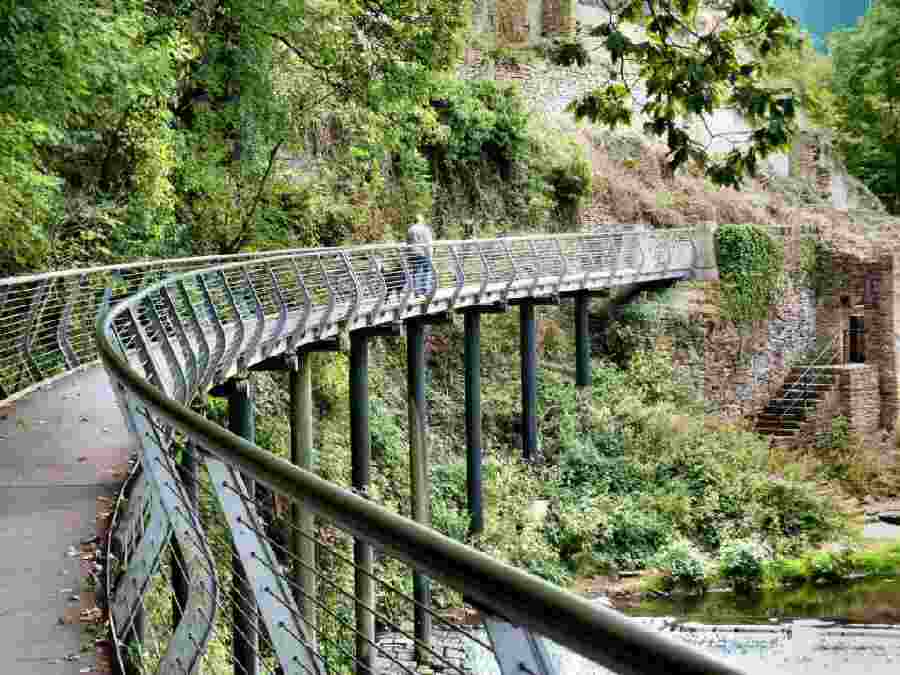
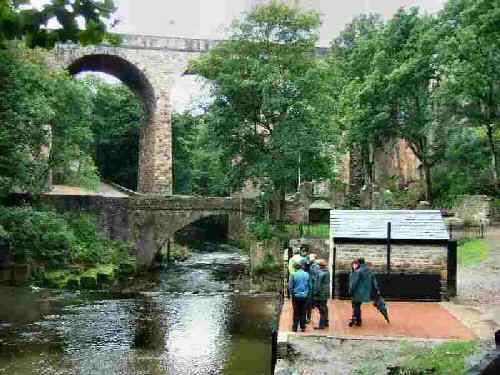
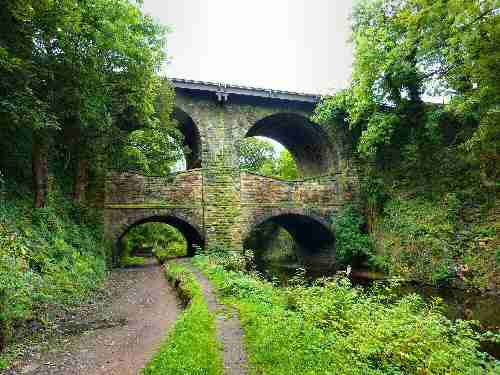
Spectacular New Mills! But many people who drive through the town by car are completely unaware of the secret beauty that lies below. The Torrs Riverside Park provides access to a dramatic gorge and an area of stunning natural beauty. The Torrs Riverside Park also contains the remains of what was an important industrial area, with the elegant Millennium Walkway winding its way for 125 yards through the gorge, high up among a canopy of trees.
The area around where New Mills is today was formerly part of the Royal Forest following the Norman Conquest. It was not until 1391 when a corn mill known as ‘Berde’, located near the site of the present Salem Mill, took the name New Mill, that the present town was born. The town marked the occasion by celebrating its 600th anniversary in 1991.
INDUSTRY
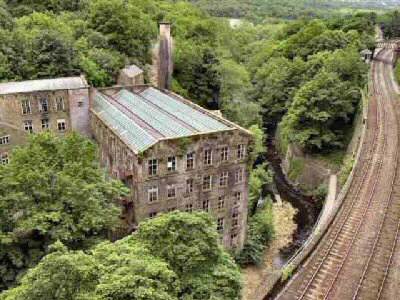
The ingenuity of Sir Richard Arkwright at Cromford in the 1770s, using waterpower to drive machinery, revolutionised spinning and weaving, and it led to the eventual collapse of the cottage industry. In the late 18th century, rapid change took place with the implementation of the factory system for spinning and weaving, driven by waterpower. The Torrs was an ideal place. Set in a natural gorge, it had the joint waterpower of the Rivers Sett and Goyt. Rocky waterfalls and cascades allowed the construction of weirs to provide a controlled supply of water. The ledges along the riverbank, above the floodwater level, were ideal to build on. The sandstone rocks at the side of the gorge meant the builders did not have to go far for their materials.
Soon New Mills became an important centre for ‘finishing trades’, bleaching, dyeing and the printing of cloth in the early 1900s. It was during this period that John Potts invented a method of engraving designs onto copper rollers, making it possible to print multiple colours by machine, an estimated 40 times faster than hand printing. This invention spread worldwide and was adapted for use on pottery as well as textiles.
ACCESSIBILITY
The main problem for the mills in the Torrs Gorge was accessibility, with narrow, steep roads that put it at a disadvantage when steam power started to replace water. The next generation of mills were built on high ground on the other side of the gorge at Newtown, alongside the Peak Forest Canal and close to the railway station and canal. The canal is now only used for recreational purposes and has a busy marina at Newtown. However, a railway service still operates from the station on the line between Buxton and Manchester. On the opposite side of the gorge, New Mills Railway Station serves the Hope Valley. It provides a regular service between Manchester and Sheffield.
In 1884, the problem of access between New Mills and Newtown, on opposite sides of the gorge, was solved with the building of the mighty Union Road Bridge, one of the highest road bridges in this part of the country. Despite this, it hardly seems as if you are crossing a bridge, because the high parapets hide the view of the gorge.
THE TORRS MILLENNIUM WALKWAY
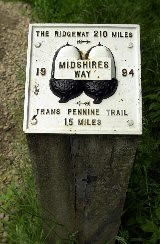
The Torrs Millennium Walkway, built for 525,000, with almost half of the money coming from the Millennium Commission. The Derbyshire County Council’s in-house engineers, not specialist bridge designers as might have been expected, constructed it. The walkway spans the otherwise inaccessible cliff wall above the River Goyt – part on stilts rising from the riverbed and part cantilevered off the railway retaining wall. It provides the final link in the 225-mile-long Midshires Way. Most definitely, it is well worth making a special journey to New Mills to cross, as many people already have done.
HOUSING
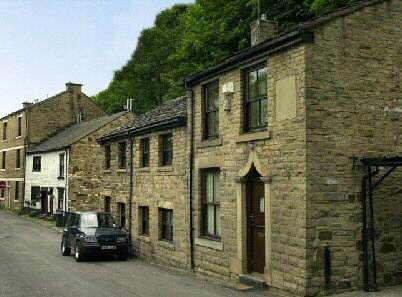
In a town where flat land is hard to find, workers’ houses were often built in rows or groups on the steep hillside. There could be as many as four or even five storeys on the downslope beneath the main house on the top, creating an under-living. Even today, there are examples on Station Road and Meal Street, where one family occupies the upper half and another the bottom half.
THE TOWN
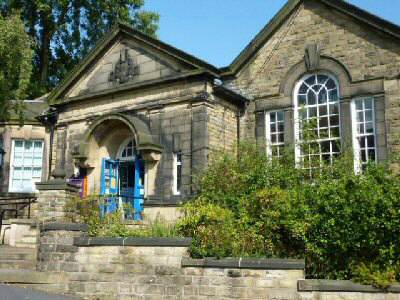
The Town Hall stands in a prominent position on Spring Bank, with the Carnegie Free Library at the rear. Built in 1909, the library contained nearly 7,000 books. But the readers were not allowed to examine them; they had to choose a book from a catalogue list and check the indicator board to see if it was available. When the selection was complete, the number was given to the librarian, and she would hand the book over, with a reminder, ‘Wash your hands.’ On the opposite side of Hall Street, a plaque with the words ‘Constabulary’ identifies where the police station once stood. Here, six ramblers spent a night in the cells in 1932, before standing trial at Derby Assizes, following the mass trespass on Kinder Scout.
TEN FASCINATING FACTS ABOUT NEW MILLS
1. New Mills Heritage and Information Centre, housed in a converted stone building of considerable character, includes a shop and sales area, a variety of displays. Refreshments are also available.
2. Opposite Torr Top Car Park is the site of the earliest textile activity in New Mills, where the weavers’ cottages once stood.
3. On the corner of the bend in the road below Top Torr Car Park is the location where the chain horses were stabled. The horses pulled heavy loads by chains attached to the carts, rather than the more rigid wooden shafts. It assisted them in negotiating the steep hills and dangerous bends.
4. St George’s Church, consecrated in 1831, stands on the corner of Church Lane and Chapel Road. It has eight bells and a four-dial clock commemorating the coronation of Queen Elizabeth II in 1953.
5. Outside what used to be the town prison in Dye House Lane, is one of the most unusual notices that you are ever likely to read. It relates to Thomas Handford, who was never sober for the space of a whole week. He was out drinking with his friend Stafford, in the Cock Inn, next door to the prison, when his friend fell dead. He walked out of the pub and resolved never to drink again. The notice entitled ‘The Drunkards Reform Cottage’ tells the rest of the story.
6. ‘A working man, a teetotaller for ten years, who was formerly a notorious drinker and a notorious poacher has recently invested his sober earnings in the purchase of the town prison which he has converted into a comfortable dwelling house. Frequently an inmate of the prison whilst a drunkard and poacher, he is now owner of the whole and occupier of the premises. Thomas Handford 1854’.
7. The Plain English Campaign headquarters are on Union Road, from where they conduct an important international business. They have been established in the town for over 20 years.
8. Archie has it that it is known as an Archimedes Screw, on the site of the Torr Mill, which was destroyed by fire in 1912. It stands in the same position as the original waterwheel that powered the old mill back in the 19th century and provides electricity for the local Co-op Store.
9. The Town Hall, in addition to housing the Town Council’s offices and Council Chamber, is used by other public services, including the Registrar and Citizens’ Advice. In 1997, the addition of a footbridge and disabled parking area to the main hall allowed for greater access to the building.
10. In 1713, the ten hamlets of Bowden Middlecale were divided into three groups, with Beard, Ollersett, Thornsett and Whitle forming a separate township. After the division, a new corn mill was erected at Ollersett and the name New Mills gradually evolved, being adopted as the official name of the parish formed in 1844.
NEW MILLS MILLENNIUM WALKWAY WALK