INTRODUCTION
Mayfield is a large ancient village situated on the outskirts of Ashbourne. It comprises the hamlets of Upper Mayfield, Middle Mayfield, Lower Mayfield, Church Mayfield and Mayfield and dates to the Saxon era. It sits on the banks of the River Dove, which forms the boundary between Derbyshire and Staffordshire, and is on the Staffordshire side of the border, but it has an Ashbourne postal address.
There has been a church in Mayfield for well over a thousand years and a mill in the village since at least 1291, when most of Mayfield was in the ownership of Tutbury Priory. There have been several owners of the mill since then, and it has been used for various purposes. For almost 200 years, textile production took place at the mill. In 1934, the William Tatton Company started to process silk from the site. Further changes in ownership have taken place in recent years before closure in April 2025.
VISITOR GUIDE
There is a long list of listed buildings that add to the enjoyment of those people who come to explore this fascinating village. Visitors can enjoy a self-guided walk by obtaining a leaflet or downloading one from the Mayfield Heritage Group website. Information boards are also strategically placed around the village.
MAYFIELD MILL
It was originally a corn mill, first mentioned in 1291. It became a cotton mill in 1793 but burned down in 1806 and stood derelict until 1816, before being rebuilt with cast-iron and vaulted brick ceilings to reduce the fire risk. It was modernised and enlarged in 1866 by Joseph and George Simpson, a Quaker family. The business was owned by Simpson Bros Ltd. until 1932, when it was purchased by Mr C.H. Cowlishaw, a Uttoxeter solicitor. By December 1934, he had sold it to William Tatton and Co. of Leek, and manufacturing changed to silk. In the 1960s, the main buildings and chimney were demolished. In 1980, the mill became the home of Mayfield Yarns, which manufactured a range of synthetic yarns, but closed in 2025.
The separate manufacturing site at Hanging Bridge is now home to Bowmer Bond, a long-established manufacturer of woven webbing used in industrial, safety, automotive, and military applications.
THE HANGING BRIDGE
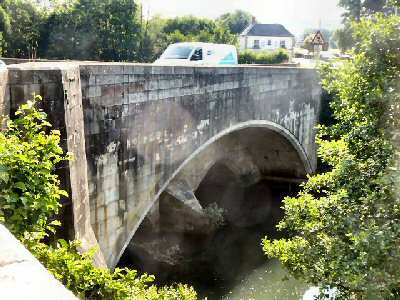
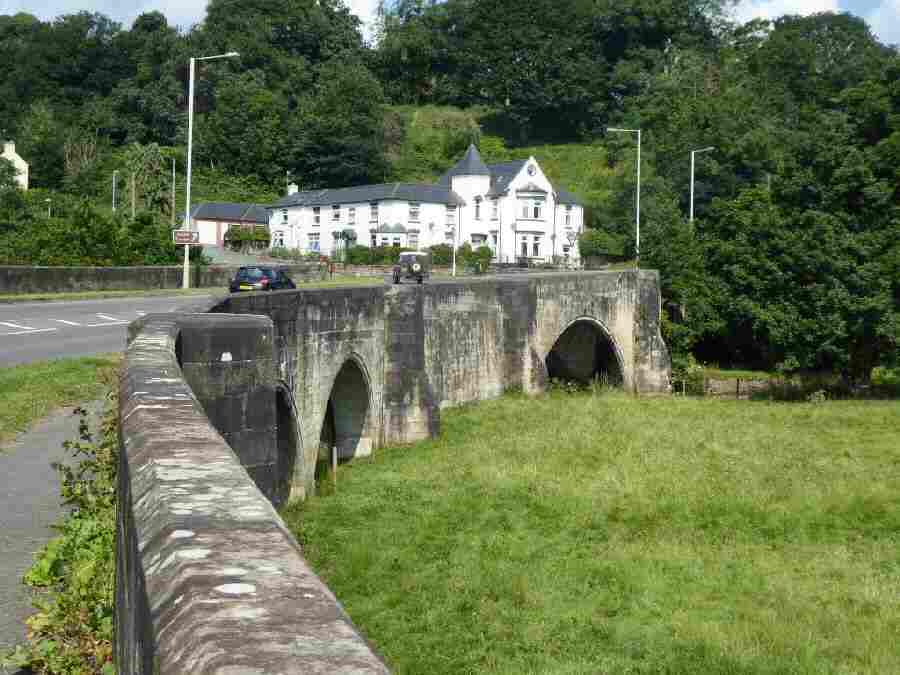
Mayfield Bridge over the River Dove that divides Staffordshire and Derbyshire was originally a narrow packhorse bridge often referred to as the ‘Hanging Bridge.’ It was only 14 feet wide before enlargement in 1937. Because of the actions of Bonnie Prince Charlie’s soldiers, who were returning north after the plan to march to London and overthrow the monarchy had been controversially abandoned. Some of the soldiers killed two villagers, but those responsible were caught and hanged from gallows over the side of the bridge. It has resulted in claims that the bridge got its name following the hanging of the soldiers. But this does not seem to be the case, as according to the Mayfield Heritage Group, it was known as the ‘Hanging Bridge’ for at least 200 years previously.
THE OLDEST HOUSE
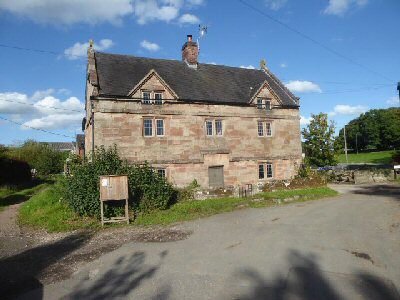
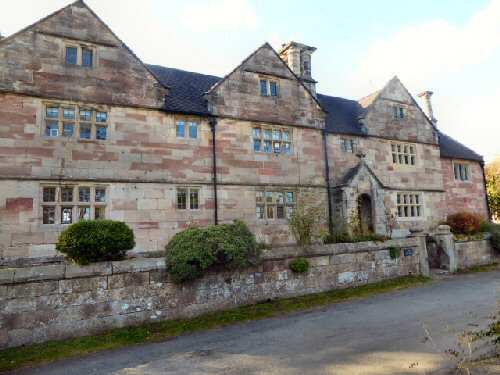
Old Hall Farm is the oldest house in Mayfield, parts of which date from 1440. Originally moated and thought to have replaced an earlier timber-framed dwelling. Built to house stewards of Tutbury Priory, the crosses on the apex of each gable mark its ecclesiastical origins.
ST JOHN THE BAPTIST CHURCH
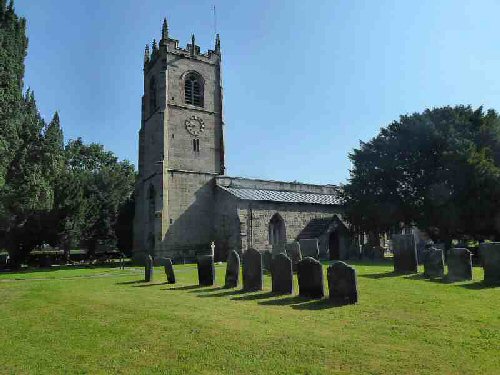
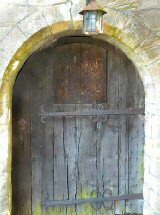
A Norman church replaced a Saxon structure at Mayfield in 1125, and in 1515 a tower was added, which had one bell, to which five more were added later. The villagers took refuge in the church in 1745, when Bonnie Prince Charlie’s soldiers passed through the village. They locked themselves in behind the west door, and the Jacobite soldiers fired shots through the door to frighten them. The musket ball holes still exist in the woodwork. The Saxon cross in the churchyard once stood, together with the village stocks, on the boundary between Upper and Middle Mayfield.
WELLINGTON MEMORIAL
Alongside the north wall of the churchyard of St John the Baptist, there is a war memorial to six men from RAF Wymeswold who lost their lives when their LP397 Wellington bomber crashed nearby in a thunderstorm on 13 June 1944. The unveiling of the memorial took place on 12 June 2011.
THOMAS MOORE
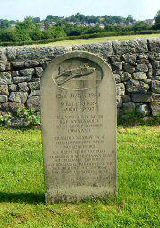
Thomas Moore was an Irish-born poet, singer and songwriter, best known for “The Minstrel Boy” and “The Last Rose of Summer”. Born in Dublin in 1779, he lived in a house on Slack Lane, Mayfield, from 1811 to about 1815. There, he wrote works including “Lalla Rookh” and “Those Evening Bells”, inspired by the bells of Ashbourne Church across the river. His journal records visits to his country cottage by Lord Byron and other notable figures. After moving to London, Moore returned to Mayfield twice. His young daughter, Olivia Byron Moore, died in 1815 and is buried in Mayfield churchyard. Her middle name reflects Moore’s friendship with Lord Byron, regarded as one of Britain’s greatest poets. Moore is considered Ireland’s equivalent of Scotland’s Robert Burns.
WELL DRESSING
Mayfield Well Dressings was restarted in 1995 after a student researching a thesis on well dressing in Derbyshire visited Old Hall Farm and asked to see the wells. It led to the Mayfield Heritage Group carrying out research about the first two well dressings in the village in 1896 and 1897 and the consequent reinstatement of well dressing. Mayfield is one of a small handful of well-dressings outside Derbyshire.
TEN FASCINATING FACTS ABOUT MAYFIELD
1. Following a catastrophic fire at Mayfield in 1806, the mill was rebuilt using an innovative cast-iron framework and brick vaulted ceilings. This pioneering fireproofing method was considered cutting-edge for the early 19th century.
2. The name Mayfield doesn’t mean a field of May flowers. Historians have traced the name back to the Old English words moethel (meaning meeting or council) and feld (open land).
3. In 1849, the philanthropic Simpson brothers (owners of the cotton mill) built The Terrace. This self-contained community consisted of 40 terraced cottages split into five rows, designed specifically to provide high-quality, ethical housing for their mill workers.
4. When walking past the historic Old Hall Farm in Middle Mayfield (built around 1680), several of the brick windows are seen to be filled in. This architectural quirk is a direct remnant of the 1696 Window Tax, where homeowners bricked up glass to avoid heavy taxes.
5. Modern Mayfield boasts an incredibly high quality of life. According to regional metrics, the village has an exceptionally low crime rate—sitting at 99% below the national average—making it statistically one of the safest rural communities in the entire country.
6. A ghost story centred on Lowes Cottage at Upper Mayfield in 1999 attracted the interest of both local and national media. The owners of the cottage insisted the property was haunted and the case went to court. The judge officially ruled that this was not the case despite specialist evidence to the contrary.
7. Early last century runaway lorries, down Swinscoe Bank, with inadequate brakes caused several serious accidents at Hanging Bridge. The accidents have been recorded on several old photographs.
8. The former Queen’s Arms on the corner of the A52 and the B5032 road through Mayfield was once a meeting point for the village wakes and other events. It is now in private ownership.
9. The stone to extend the Hanging Bridge was hewn from the quarry by Town End Farm in Upper Mayfield. The arches of the old bridge were retained and can be seen beneath the new bridge and probably date to the 15th century.
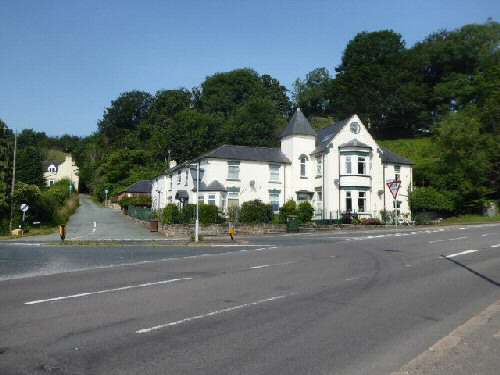
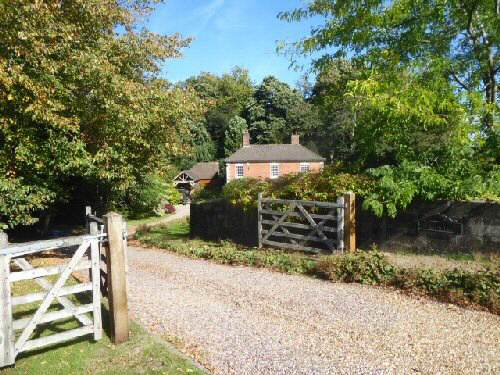
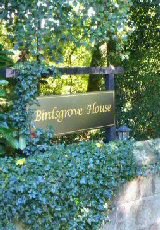
10. Birdsgrove House near the bottom of Swinscoe Hill, on the northern side, was formerly the residence of the Greaves family, the principal landowners in Mayfield. In 1939, the lease to the house was acquired by the Royal Pharmaceutical Society, which officially opened it as a dedicated convalescent home for pharmacists and their families in 1946. It later became a hotel and boutique wedding venue and is now used for holiday lets and events.
OSMASTON PARK WALK