PLAN YOUR DAY OUT
Location: From the A6 Matlock to Buxton Road, take the B5056 to the Village. Youlgreave Car Park is on the western side of the Village.
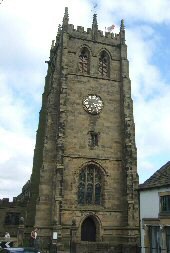
Visit: All Saints’ Church dates from around 1150-70AD, but there was probably an earlier Saxon church on the same site. The church has been developed over the centuries in many different styles. Do not miss the small, intriguing figure of a pilgrim with staff and wallet, reputedly carved by a travelling friar in return for hospitality.
Refreshments: There are three public houses in the Village. Nearby Bakewell offers a wide range of pubs, cafes and restaurants.
Walk: Much of this delightful walk is along the banks of the Lathkill and Bradford; both rivers, flowing entirely through limestone country, are famous for the purity of their water. Lathkill Dale is well known for its aquatic life, as well as being a trout river, and the banks teem with wildlife. The walk along Bradford Dale not only provides an opportunity to admire the scenery, but also to note the varying styles of bridges across the river.
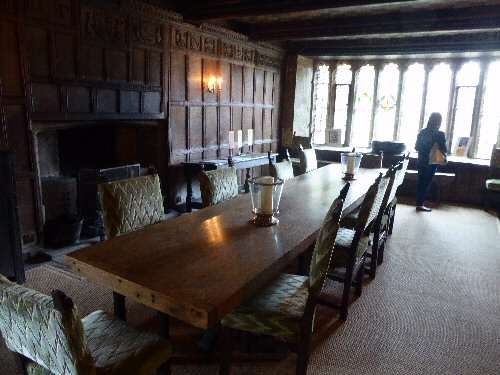
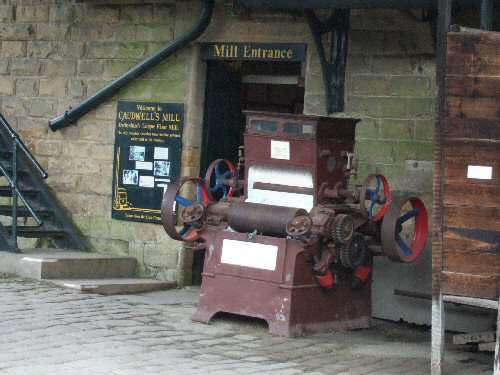
Special Places of interest in the Locality: Haddon Hall is perhaps the most perfect example of a medieval manor house in the country. The gardens are a delight and are believed by many to be the most romantic in Britain, being the setting for the elopement of Dorothy Vernon and John Manners. – Caudwell’s Mill, powered by the River Wye, is the only complete Victorian working roller flour mill in the UK. There are several artisan craft shops on the site – Visitors flock to Bakewell, to shop and explore its many nooks and crannies, to admire its fine buildings, or relax by the clear, sparkling waters of the River Wye.
INTRODUCTION
Surrounded by glorious countryside, the ancient Village of Youlgreave (Youlgrave) winds its way carefully along a narrow limestone shelf, between two of the area’s loveliest valleys. Bradford Dale to the south drops sharply down with pretty little cottages and their gardens clinging to the side of the valley; a little further away to the north, on the other side of the hill, is Lathkill Dale, considered by some to be Derbyshire’s finest dale.
The long, narrow village street runs for about one and a half miles along almost the only level ground available; the footpath being lost altogether by the church, where pedestrians, who do not want to run the risk of getting run over, walk through the churchyard.
Apart from the narrow road, one problem visitors have is knowing how to spell the name. The County Council has erected signs that say ‘Youlgreave.’ A quick check on the Ordnance Survey agrees, but the post office says ‘Youlgrave.’ Local people use the latter spelling, which is how the name is pronounced. In the Domesday Book of 1086, it was recorded as ‘Giolgrave’, and according to research, there are over sixty different spellings of the name!
THE FOUNTAIN
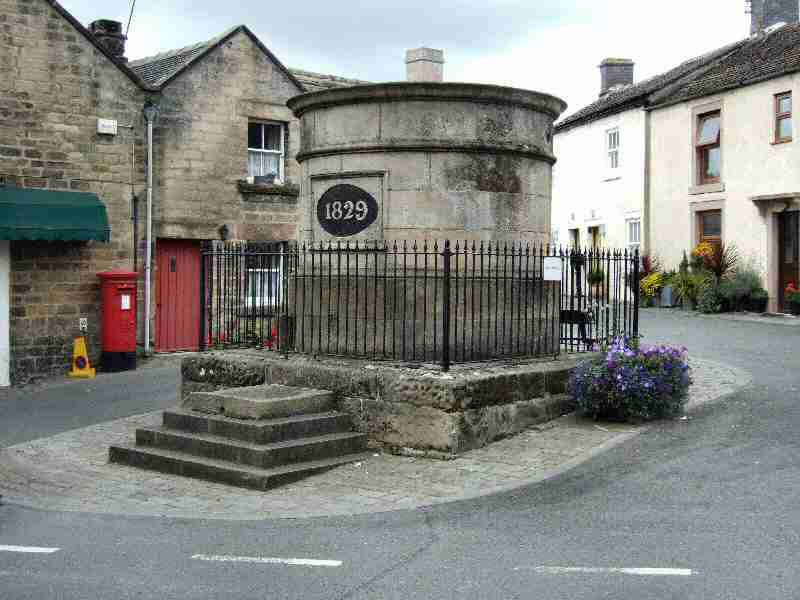
In the centre of the marketplace is a huge circular water tank or conduit head, known locally as ‘The Fountain,’ which, since 1829, has supplied soft water to the villagers, initially at an annual charge of 6d. It was built following a campaign by the ‘Friendly Society of Women,’ who demanded a cleaner, healthier, and more efficient supply of water. It certainly was more efficient than carrying the water on the torturous journey up from Bradford Dale. The Village still has its own private water company, but prices have increased!
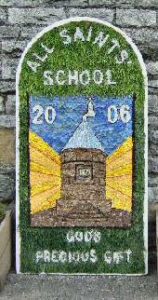
Well Dressing, or ‘tap dressing’ as it is sometimes called, was first introduced when water was piped to The Fountain, and decorated in thanksgiving for the improved water supply. On the Saturday nearest St John the Baptist’s Day in June every year, five wells are dressed to a very high standard, to which a sixth has been added. They are amongst the most widely admired in the county.
ALL SAINTS’ CHURCH
The parish church of All Saints is a magnificent structure, second only in size to Tideswell in the Peak District. Norman in origin, the font with its projecting stoop is unique in this country. An interesting entry in the churchwarden’s accounts for 1799, ‘Dog whippers had to be paid’, for whipping dogs out of the church during divine service.
Near the church are some rather grand Georgian houses. Further west is The Old Hall, a distinctive-looking Manor House, said to be haunted, dated 1656 according to the datestone, but may be earlier. At the rear is Old Hall Farm, another charming stone-built house of about 1630.
THIMBLE HALL
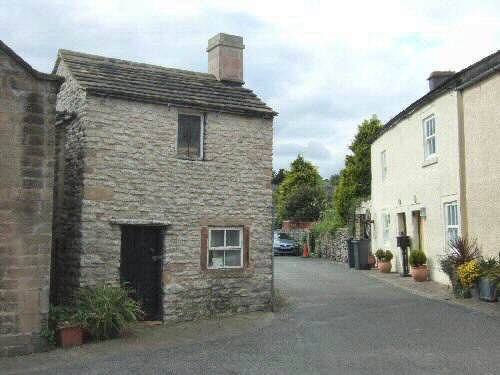
Tiny Thimble Hall, ‘one up and one down,’ situated in the marketplace, is the smallest hall in the country; it attracted considerable interest when sold in 1999. Nearby, a three-storey Victorian building used to be the Cooperative stores and still carries the advertising, but is now a thriving youth hostel. As keen cinema fans will know, the store was featured in the film’ The Virgin and the Gypsy,’ along with much of the rest of the Village, which was referred to as Congreave in the novel written by D.H. Lawrence.
PUBLIC HOUSES
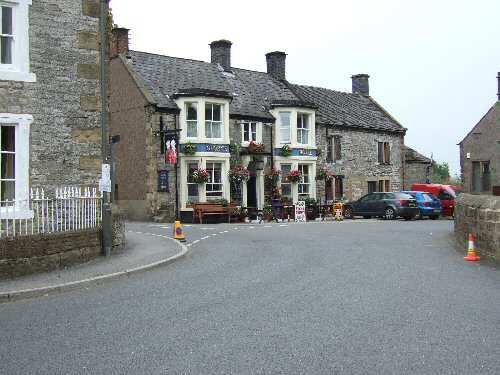
There are three pubs, The Bull’s Head, with a superb carving over the courtyard entrance, The George, and the Farmyard Inn with the amusingly named apartments to the rear of Cow Shed, Sheep Pen and Pig Sty. The Village has a variety of shops, including a post office.
YOULGREAVE WALK
TEN FASCINATING FACTS ABOUT YOULGREAVE
1. Three long-distance paths, the Alternative Pennine Way, the Limestone Way, and the White Peak Way, pass through the Village, increasing the number of visitors.
2. A Guinness World Records Certificate Names Thimble Hall in Youlgreave as ‘the world’s smallest detached house’ at 11 feet 10 inches (3.61 m) × 10 feet 3 inches (3.12 m) and 12 feet 2 inches (3.71 m) high. Each room is less than 8 feet square, and there was a fixed ladder to the bedroom at the time of the award. It is a Grade II listed building.
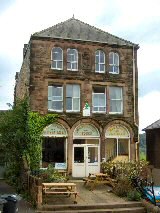
3. The former Youlgreave Cooperative Society shop, now a Youth Hostel, played an important role in supplying credit to families in the Village in hard times.
4. The waterside path beside the River Bradford, which runs from Alport to Middleton-by-Youlgreave, is very popular with walkers.
5. The precise origin of the Village’s unusual nickname of ‘Pommy’ is uncertain. But it is probably connected with the local band. When the instruments were first purchased, only a few members of the band knew any music, so parades were not particularly tuneful, but more of a repetitious ‘Pom, pom, pom.’
6. Another version of ‘Pommy’ is of a pig resting on a wall serenading the band as it passed by!
7. In the churchyard is the gravestone of Jane Shimwell, wife of Alexander McDougal, who invented self-raising flour (she became Lady McDougal when he was knighted).
8. Football and cricket are played at the Recreation Ground, where county cricketers have played benefit matches in the past.
9. Youlgreave was an important centre for lead mining; the Mawstone Mine even reopened after the First World War in anticipation of increased demand, only to cease production permanently in 1932.
10. An explosion in that year killed five of the six miners working underground, and three of the rescue party died due to carbon monoxide poisoning.
YOULGREAVE WALK