BRADWELL VISITOR GUIDE

Bradwell Village
Bradwell Village

PLAN YOUR DAY OUT

Location:    On B6049 between the A6187 Hathersage to Hope Road and the A623 Baslow to Chapel-en-le-Frith Road.

Visit:    South of Bradwell, the Roman fort of Navio, originally built of wood in the first century AD, but later rebuilt in stone and became home to around 500 soldiers. Although very little remains today, some of the stones used to build the fort still exist. The fort was occupied continuously for around 350 years, and linked with the larger fort of Melandra, in the North West, near Glossop, and in the South, with Aqua Arnemetiae at Buxton.

Refreshments:    Ye Olde Bowling Green is a large, sprawling, but comfortable 16th-century pub at the foot of Smalldale. Open for breakfast, lunch, and dinner, with seating outside and good views. The Brook Café Coffee Shop at Brookside.

Walk:    In an area where most walkers head for Castleton and Edale, this walk will come as a pleasant surprise, with its glorious views and fascinating historical information.

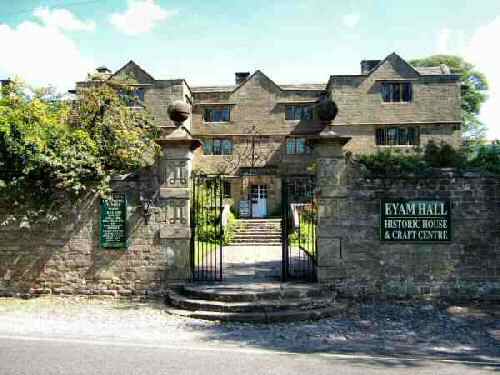
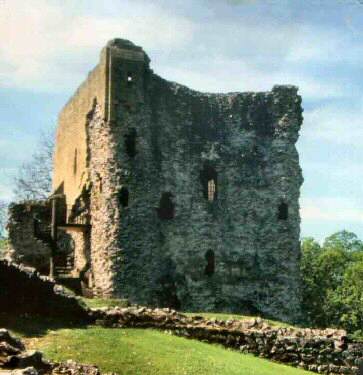
Special Places of Interest in the Locality:    Eyam Hall, a fascinating 17th-century manor house that has been the home of the Wright family for over 300 years. Please visit the website for more information and opening details. – Peveril Castle, an impressive Castle with a square tower, built in 1176 by Henry II, provides breathtaking views over Castleton and the surrounding countryside. Under the care of English Heritage, it is a Silver Green Impact Award holder. – Derbyshire and Lancashire Gliding Club at Great Hucklow is a members’ club, but also offers trial flights for visitors. The club opened in 1935, at Camphill Farm, on the edge of an escarpment above the village of Bradwell. There is a large car park where visitors can sit /picnic, and watch the gliders taking off and landing.

Eyam Hall
Eyam Hall
Peveril Castle, Castleton

INTRODUCTION

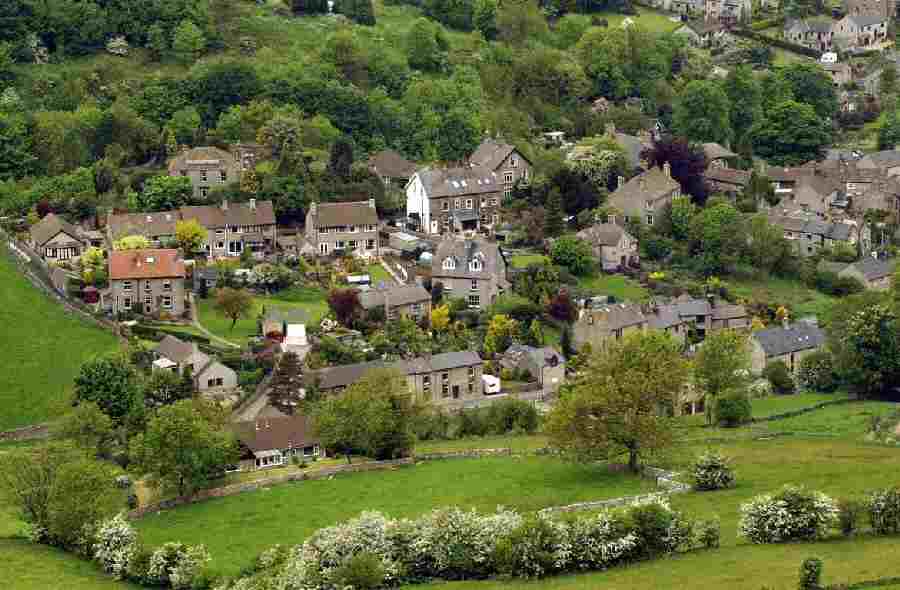
Hidden from the main road, the centre of Bradwell clings to the steep hillside. Tiny individually shaped cottages set at odd angles, among a profusion of narrow winding streets and alleyways, give the appearance of a picturesque Cornish fishing village, with just the sea and several thousand gallons of whitewash missing.

Local author and 19th-century chronicler Seth Evans, who wrote two books about Bradwell, famously described it in the following words. “It’s steep winding streets – if streets they can be called – and all sorts of queer little out of the way places running in and out in all directions, breakneck, oblique, skew-tilted, beginning everywhere, leading nowhere, make the stranger feel that he is living in medieval times”. There were no planning regulations to worry about in those days, and people simply built where they could find a space.
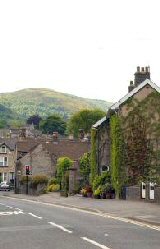
Bradwell
Bradwell

THE ROMANS

Bradwell had its origins in lead mining, which has takenplace in the area since the Romans. There was a Roman Fort at Navio, constructed at the meeting point of the River Noe and Bradwell Brook, to control the lead mining industry in the area. According to a local legend, some of the inhabitants of the village descended from convicts, the Romans often using convicted prisoners to work in the metal mines.

LEAD MINING

In its heyday, the village was one of the most important lead mining settlements in Derbyshire. Most of the inhabitants were involved, the men down the mines, or at the lead smelting works, the women and children washing and sorting the ore. There were several large mines on Bradwell Moor and numerous small ones in the hills around the village. Hungry Lane, which leads back to the village from the neighbouring hills, is said to be called that because it was the return route used by the miners at the end of the day, cold, wet, tired and hungry!

BRADWELL DALE

The road is lined with cliffs for about three-quarters of a mile as you approach the village from the South. This is Bradwell Dale, which is considered one of the most beautiful valleys in the county. On reaching the village, the lack of obvious long-term parking facilities seems to invite drivers to press on towards Castleton and Edale. It is a pity, because although Bradwell is very much a working village and not a recognised tourist trap, it does have a lot to offer, as well as excellent walking and beautiful scenery.
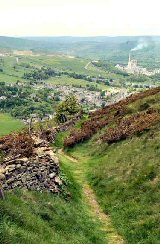
Bradwell Edge Path
Bradwell Edge Path

INDUSTRY

The miners wore ‘Bradder Beavers’, a hat styled in the fashion of a military helmet, said to be the prototype of the ‘tin hat’. A candle on top of the hat lit the way down the mine. The hats became very popular and were used widely throughout Derbyshire. Although initially designed for lead miners, other uses were found, and their popularity spread well beyond the county boundaries.

The demise of lead mining did not result in the collapse of the local economy, as other forms of employment included silk weaving, cotton spinning, and clog making. And more unusually, Bradwell became the local centre of the optical industry, producing telescopes, opera glasses and spectacles.

Some of the women worked in the cotton mill at Bamford, a twelve-hour day starting at 6 a.m. They had to undertake the long journey twice a day, whatever the weather. To ensure they did not oversleep, a ‘knocker-up’ was employed to go around the houses in the morning. He carried a long pole, knocked on the windows, and called out the women’s names.

SAMUEL FOX

Samuel Fox, the son of a shuttle maker, was born in Bradwell in 1815; he had an inventive mind and a capacity for hard work. He not only founded the massive steelworks at Stocksbridge, near Sheffield, but also gained worldwide recognition by designing the folding-frame umbrella. A benevolent man, he never forgot his home village, providing money to build a church, a site for the vicarage and setting up a trust fund for annual distribution to the poor and needy.

LOCAL CUSTOM

An interesting custom for many years was for youths to stretch a rope across the road and not allow the bride and groom to reach the church before they had paid a toll. The money was then usually spent in the nearest hostelry, when no doubt a toast to the bride and groom was drunk!
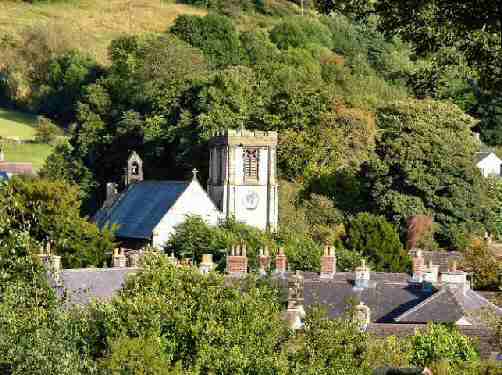
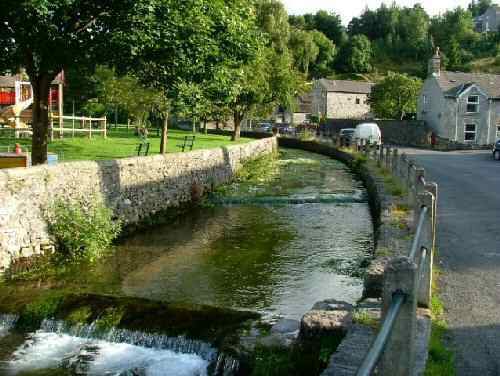
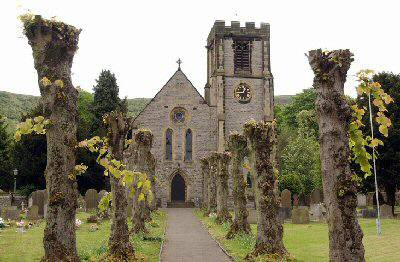
St Barnabas Church and Bradwell Village
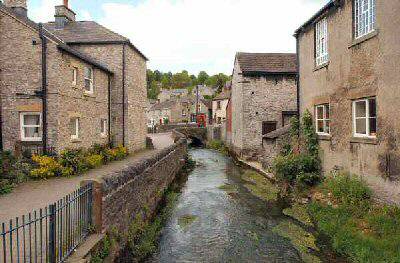
Brookside, Bradwell
Brookside, Bradwell

TEN FASCINATING FACTS ABOUT BRADWELL

1. The oldest building in the village is Hazlebadge Hall, which dates to 1549, and stands at the top of Bradwell Dale on the road to Tideswell – the crests of the Swynnerton and Vernon families are on its gable end. The building which survives today is but one wing of a much larger hall, owned by the Vernon family, local landowners who inhabited the hall for some three hundred years.
2. On the moors of Bradwell’s Northern edge lies a large Dark Age mound with a ditch that runs from Bradwell Edge to Micklow Hill. Known as the ‘Grey Ditch’, it is thought to have been built as a defensive barrier between the Anglo-Saxon tribes of Mercia and Northumbria, and constructed between the fifth and sixth centuries. Excavations have revealed the bank was about 8 metres wide at its base, and 1.2 metres high. Some historians think Bradwell or ‘Broad Wall’ may have derived its name from the ditch.
3. Bradwell Brook flows through the village’s main street; most of the cottages in the village date from the eighteenth and nineteenth centuries.
4. There are several inns in the village, including the White Hart, which dates back to 1676.
5. The primary source of employment in the area is the Cement Works at Hope and the local quarries.
6. In 1807, lead miners working in Mulespinner Mine discovered Bagshawe Cavern. It takes its name from Lady Bagshawe, who, together with her husband, owned the land and visited the mine soon after its discovery.
7. Bagshawe Cavern has an extensive network of chambers, some of which have not been fully explored. A variety of trips at all levels, from a walk around the old show cave to a vertical descent into the lower streamway series for the enthusiast. For further information, visit the Cavern website.
8. The building of the Church of St Barnabas in 1868 enabled the Anglicans to worship in their own village instead of having to go to the church in Hope. Many of the villagers, though, attended non-conformist services.
9. Bradwell Edge is popular with hang gliders and paragliders and offers stunning views which cover the Ladybower Dam and Win Hill to the North, with Losehill and Kinder Scout visible beyond.
10. In 2020, the residents of Bradwell constructed a handmade water wheel from two bicycle wheels and washing-up bowls to power their Christmas lights. It illuminated 3,000 LED lights along the brook, and the villagers claimed it was the only one of its kind in the UK.

BRADWELL EDGE WALK

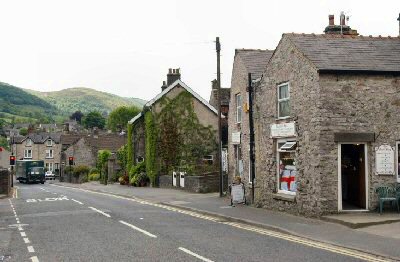
Main Street, Bradwell
St Barnabas Church, Bradwell
Bradwell Village
Bradwell Village