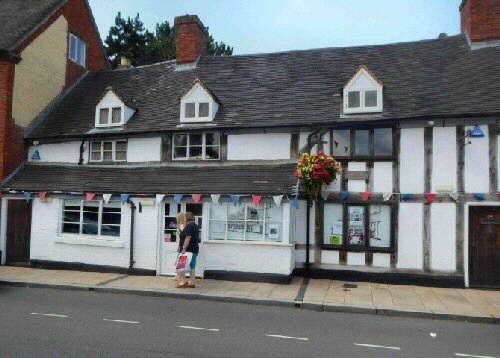
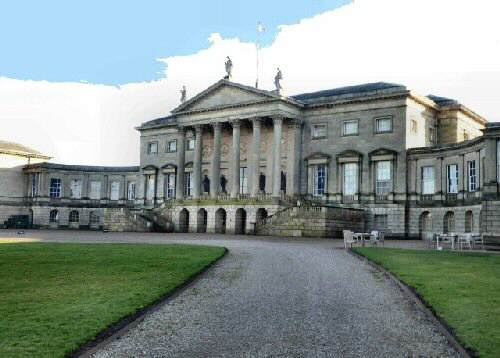
INTRODUCTION
Hilton is one of South Derbyshire’s most intriguing villages — a place where medieval history, modern expansion, and unexpected curiosities sit side by side. Located just off the A50 and roughly equidistant from Derby and Burton upon Trent, Hilton has transformed from a small agricultural settlement into one of the fastest-growing communities in the region. Yet despite its size and pace of development, it retains a distinctive character shaped by its riverside setting, historic buildings, and a surprising number of stories.
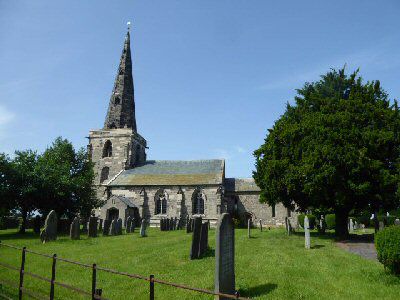
The village appears in the Domesday Book of 1086 as “Hitaine,” valued at ten shillings and held by Henry de Ferrers. For centuries it remained a modest rural township linked to nearby Marston on Dove. The 13th-century church of St Mary still stands with its remarkable 1366 bell — the oldest in Derbyshire, which was cast in Leicester and inscribed with the words Hail Mary’ by John de Stafford.
REGENERATION
Hilton today has been shaped by one of the largest regeneration projects in Derbyshire. The village expanded dramatically from the 1990s onwards, with the building of thousands of homes on the former Ministry of Defence vehicle depot. Developers transformed the 280-acre site into a new community complete with schools, parks, business units, and retail spaces. Today Hilton is a thriving commuter hub with a population of more than 8,200.
AROUND HILTON
Despite the rapid increase in population, Hilton remains close to nature. The River Dove flows close to the village, offering peaceful walking routes and an abundance of wildlife. Several former gravel pits around the village have become nature reserves managed by Derbyshire Wildlife Trust, attracting birdwatchers who come to spot seasonal rarities. The Lavender Patch in the grounds of Hall Croft Farm is a big favourite in the summer when butterflies fill the gardens and lavender scents the whole farm. Visitors can take tea outside in the lavender fields.
FLOODS
Flooding along the Dove encouraged the settlement to move slightly uphill, forming the Hilton we know today. However, this did not entirely solve the problem, and the village has flooded in more recent years.
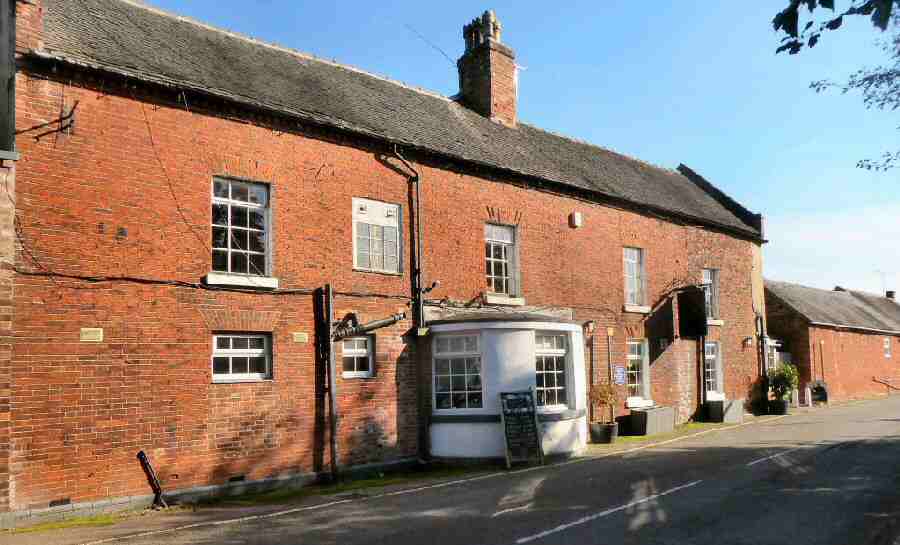
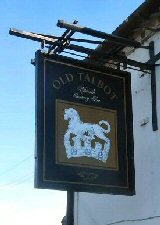
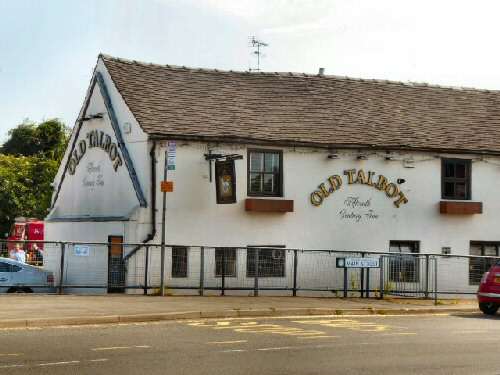
Roads near a brook in a village flooded after heavy rain overnight in late August 2026. The landlord of the Old Talbot pub, in Main Street, described the downpour as “biblical”, with water coming in through the front door. Then “the next thing I knew, the car park was flooded, so we had water coming in through the back door as well,” he added. The pumps were still working, and the locals carried on as normal and waded through the water to the bar when they wanted another pint.
BUILDINGS
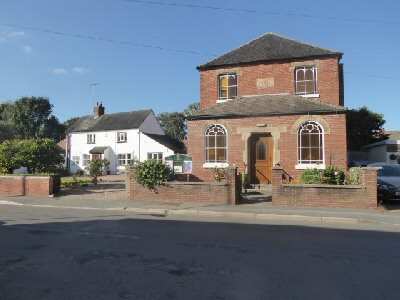
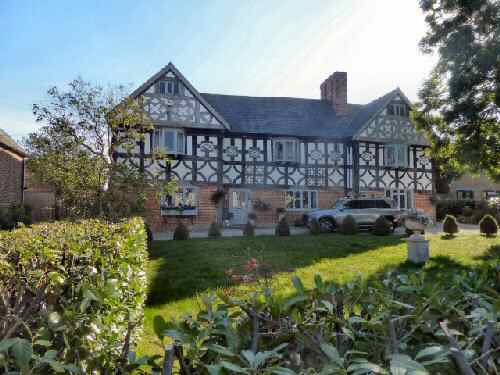
One of Hilton’s most distinctive historic buildings is Wakelyn Hall. In this half-timbered 16th-century house, Mary, Queen of Scots is said to have stopped on her way to imprisonment at Tutbury Castle. Other notable buildings include the Old Talbot Inn — a 15th-century pub full of character — the Wesleyan Chapel, Hilton Lodge, and the Georgian Hilton House Hotel, now the Hourglass.
BUSINESS PARK
Hilton is home to several small businesses and a Business Park. It is home to the huge premises of both Hilton Garage car supermarket, which houses around 1,000 to 2,000 vehicles, and Don Amott Leisure Kingdom, which celebrated its 50 years of trade in caravans and motorhomes in 2013. Aldi’s arrival in 2016 followed years of speculation, rejected planning applications, and local debate. When it opened, it was a great success, so much so that a larger Aldi has been opened in a different location to replace the original.
HILTON HOUSE
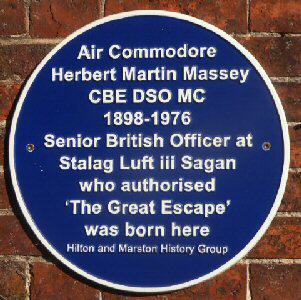
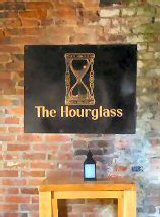
Hilton House is a Georgian-built family home converted into a hotel in the 1960s. The hotel is licensed for civil weddings and has a sizeable function room, 10 bedrooms and a public bar. It went into administration in February 2023, but it has reopened following renovations to become the Hourglass Wine Bar. It was the birthplace of Herbert Massey — the RAF officer who authorised the Great Escape at Stalag Luft III during the Second World War. Massey’s role in one of the war’s most famous episodes is commemorated with a blue plaque supplied by the Hilton and Marston History Group.
HERBERT MARTIN MASSEY (1898-1976)
His connection gives Hilton a remarkable link to global wartime history. Visitors often find it surprising that such a quiet Derbyshire village produced a figure central to one of the most dramatic POW stories ever told.
At the age of 16, he went to the Royal Military College at Sandhurst.
He was seriously injured when German ace flyer Werner Voss shot down his plane. However, after the War, he continued his flying career in the Royal Air Force.
In 936, he was again almost killed in Palestine during an incident for which he received the Distinguished Service Order (DSO). He was shot down again in 1942 over Holland but survived and was taken prisoner by the Germans and sent to Stalag Luft III, where he was the Senior British Officer.
In 1944 he authorised the Great Escape from the Prisoner of War Camp. He did not join the escape himself as he was too badly wounded, but it was to him that the Germans first broke the news of the execution of fifty of those recaptured. Following his repatriation to Britain, he reported the War crimes, and the authorities began the process of convicting the perpetrators.
10 FASCINATING FACTS ABOUT HILTON
1. Hilton’s earliest recorded history is listed in the Domesday Book of 1086 as “Hitaine.” It was held by Henry de Ferrers, one of William the Conqueror’s most powerful Norman landowners, and valued at ten shillings — a modest but notable sum for a rural manor. At that time, Hilton would have consisted of scattered farms, smallholdings, and open fields worked communally. Its population was tiny compared with today’s.
2. The Old Talbot Inn is one of the village’s most characterful buildings, dating back to the 15th Century. With its traditional architecture, cosy interior, and long history of serving travellers on the old Derby–Uttoxeter road, it offers a glimpse into Hilton’s past as a rural stopping point. The inn would have welcomed farmers, traders, and coach passengers.
3. The River Dove flows close to Hilton, offering scenic walks and peaceful views. Surrounding former gravel pits have been transformed into nature reserves managed by Derbyshire Wildlife Trust, attracting birdwatchers and nature lovers. Hilton Willow Pit, once an industrial site, is now a thriving habitat for bats, dragonflies, and wetland species. These reclaimed sites, from industrial workings to ecological havens, are one of Hilton’s most striking success stories.
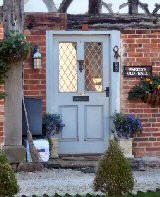
4. Hargate Equestrian Centre, just outside Hilton, offers riding lessons for all ages and abilities. Its presence reflects Hilton’s rural roots and provides a popular leisure activity for families. The centre’s paddocks, stables, and countryside setting make it a valued part of the local landscape.
5. Hilton’s location near the A50 makes it a prime commuter village for Derby, Burton upon Trent, and the wider East Midlands. Its modern housing, schools, and amenities attract families seeking both convenience and countryside. The village’s growth reflects its strategic position and excellent transport links.
6. Hilton Brook is a tributary of the River Dove and is 16 miles long. Like many watercourses in the area, it has multiple names, often being named locally after the village it flows past. The source of the brook is to the north of Hulland village. Its Journey ends when it joins the River Dove north of Burton upon Trent near the village of Egginton.
7. A World War Two military depot is visible as structures on aerial photographs of Hilton dating to 1945, mapped during an aerial photographic mapping survey undertaken as part of the Derbyshire and Peak District Aggregates Assessment Project. The Army depot occupies a site of approximately 270 acres. Although it was an Army unit, it was totally manned by civilians.
8. The site was developed during World War Two as a base for the US Army Engineers, with some 3,000 American servicemen stationed on it. It was especially suitable because of the railway at nearby Egginton Junction, which made the transport of troops and equipment easier. Parts of the Mulberry Harbour used after the D-Day landings were assembled here. After the War, the site was taken over by the British Army and used for storage of anti-aircraft guns, searchlights, etc.
9. Hilton Party on the Park is an annual community event organised by a volunteer committee and held on the village playing fields. Admission is free, and the event features live music, family entertainment, food and drink vendors, local businesses, community organisations, and fundraising activities. The committee’s aim is to bring together residents of Hilton and the surrounding area through community events while supporting local groups and organisations.
10. The Wesleyan Chapel in Hilton, a classic Victorian brick-built chapel, is now widely known as the Hilton Methodist Chapel. It is a historic place of worship located on Main Street in the centre of the village, erected in 1841 at an initial construction cost of £450 and built to accommodate a seating capacity of 500 people. A prominent datestone on the structure reads “Wesleyan Chapel 1841”.
ETWALL MICKLEOVER RAILWAY WALK